

Now available in select markets. Not yet cleared or available for sale in the US.

ACIST Pro

Diagnostic System

Experience ACIST Pro

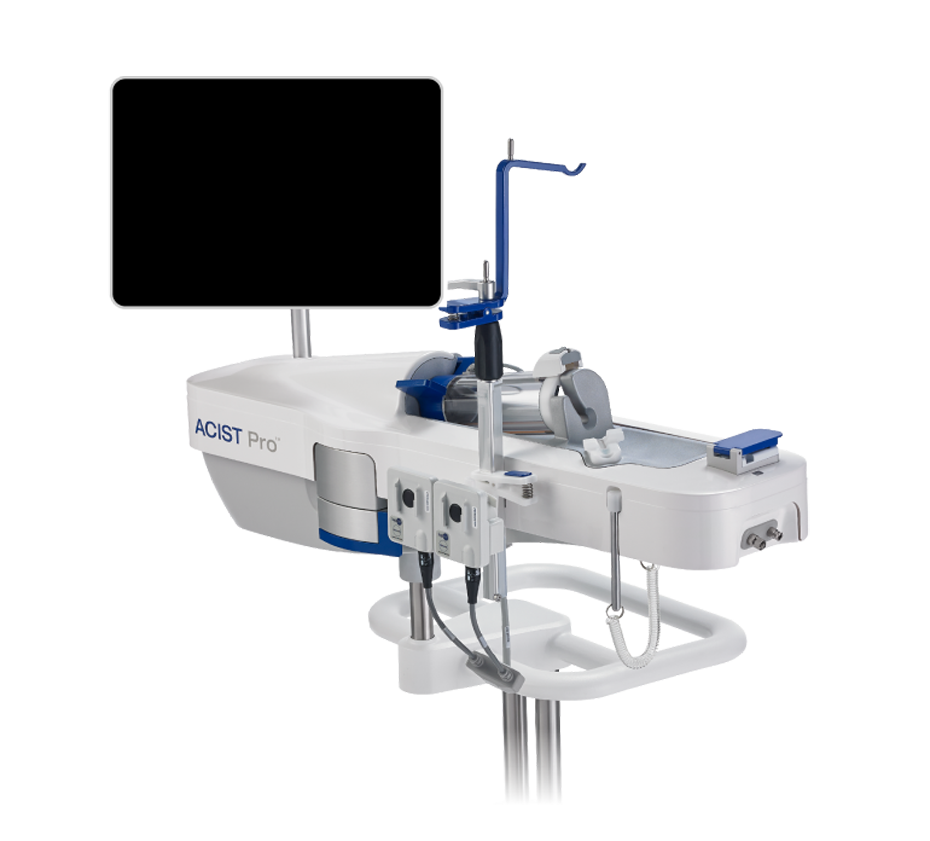
The ACIST Pro System is a next-generation, variable-rate contrast management system designed for precise delivery of contrast media in interventional cardiology.

Your tech-forward solution

From an intuitive user interface to visual prompts that simplify troubleshooting and setup, ACIST Pro delivers enhancements to drive even more clinical and economic value.

machine
Touchscreen/User interface
Touchscreen

Touchscreen/User interface

The touchscreen is used to operate the system. A cable from the touchscreen connects to the processing unit. An optional bedrail mount for the touchscreen is also available.

Bottle Holder

Bottle Holder

There are two bottle holders; one holds the contrast bottle used during the procedure and one stores a second contrast bottle.

Syringe Sleeve

Syringe Sleeve

The syringe sleeve positions the syringe to ensure proper engagement with the motor-controlled actuator. The sleeve can be rotated to allow the syringe to be inserted and removed.

Manifold Clip

Manifold Clip

Secures the manifold in place during the procedure.

Air
Column Sensor

Air Column Sensor

The air column sensor secures the patient tubing into place and detects an air column in the tubing.

AngioTouch®
Hand Controller
Connectors

AngioTouch® Hand Controller Connectors

Allows connection of the AngioTouch Hand Controller directly to the injector. Connection of the hand controller is required, either using these connectors or by connecting to the optional AngioTouch Module.

Mallet

Mallet

The weighted mallet is used to tap the fluid pathway and components to help dislodge and remove air.

Transducer Cartridge
Holder

Transducer Cartridge Holder

The transducer cartridge holder couples the transducer cartridge to the system transducer diaphragm to read invasive blood pressure signals.

Saline Pump

Saline Pump

The saline pump delivers saline through the sterile fluid pathway, and is used to remove air and flush contrast from the patient tubing.

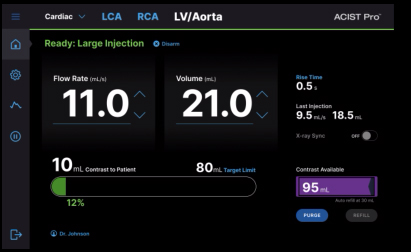
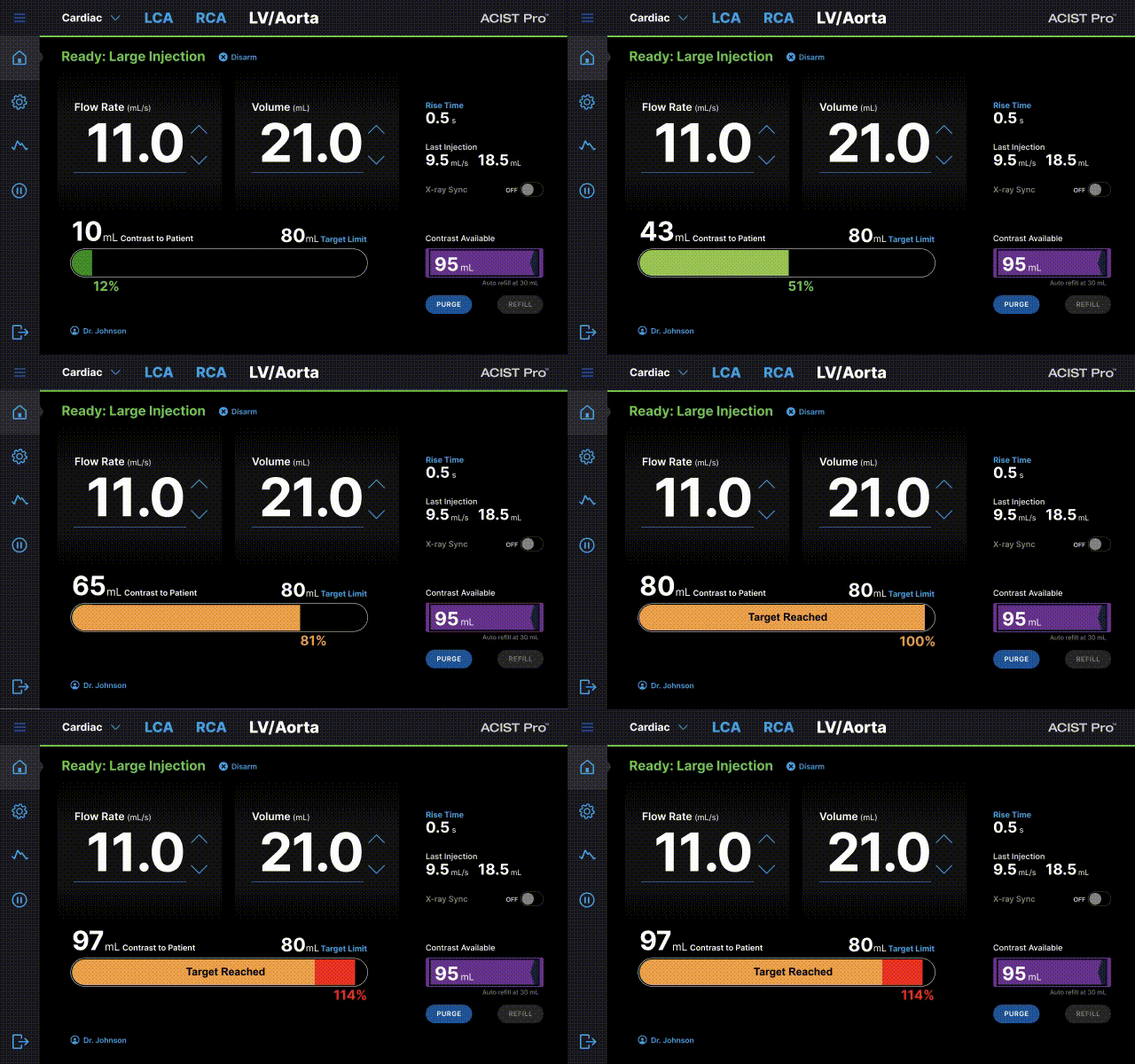
Real-time contrast tracking

A visual on-screen enables the cath lab team to monitor and report dosing in relation to the target limit, without having to do it mentally.
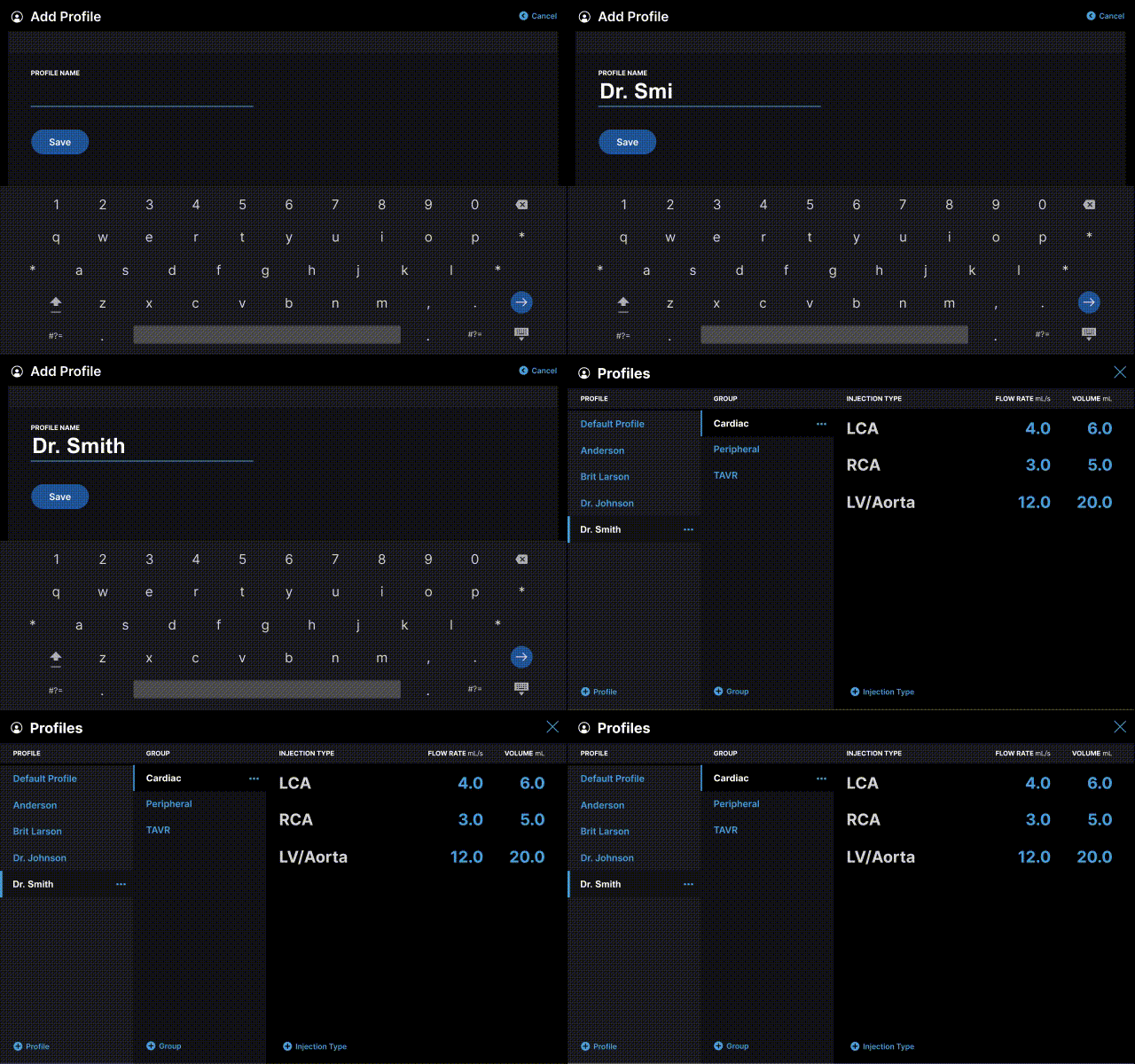
Customizable presets

Profiles facilitate customized procedure planning and setup; physicians can have customized presets based on their preferences and use cases.
On-screen troubleshooting

On-screen troubleshooting simplifies setup

Prominent contrast utilization display and customizable target limits simplifies dose management in a busy cath lab.
Profiles streamline image acquisition during a procedure; physicians or labs can customize presets for common procedures.
Step-by-step details and visuals facilitate resolution of the most frequent troubleshooting scenarios, potentially reducing downtime.

Enhanced clinical and economic value

Key enhancements may provide value above and beyond what you have come to expect from your contrast delivery system.

Setup time is

33% faster

than CVi

Up to

30% reduction in CI-AKI

vs manual injection1

Up to

96% reduction

in clinician radiation exposure*2,3

ACIST Pro

Be among the first to know!

Real-time contrast tracking

A visual on-screen enables the cath lab team to monitor and report dosing in relation to the target limit, without having to do it mentally.

Customizable presets

Profiles facilitate customized procedure planning and setup; physicians can have customized presets based on their preferences and use cases.

On-screen troubleshooting

On-screen troubleshooting simplifies setup

Citations
*AngioTouch Module may reduce radiation exposure to the operator by up to 96% depending on where user stands and placement of hand controller connection on cath lab bed.

1. Call J, Sacrinty M, Applegate R, Little W, Santos R et al. (2006) 1. Automated contrast injection in contemporary practice during cardiac catheterization and PCI: effects on contrast-induced nephropathy. J Invasive Cardiol 18 (10): 469-474.; Minsinger KD, Kassis HM, Block CA, Sidhu M, Brown JR (2014) Meta-analysis of the effect of automated contrast injection devices versus manual injection and contrast volume on risk of contrast-induced nephropathy. Am J Cardiol 113 (1): 49-53.

2. NU-CLAIM-41

3. Wilson, Robert F., John P. Gainor, and Blair Allen. “The Effect of Stepping Back From the X-Ray Table on Operator Radiation Exposure.” Health Physics 121.5 (2021): 522-530
See the instructions for use for complete indications and safety information.

Important Safety Info:The ACIST ProTM Diagnostic System is designed to be used by a physician to inject contrast media and saline during angiography. It should be used with appropriateradiographic imaging and blood pressure monitoring and electrocardiogram. Additionally, standard equipment for cardiopulmonary resuscitation and drugs for the treatment of contrast media-induced drug reactions should be available. The ACIST Pro system must be operated by or be under the immediate and direct supervision of a physician trained in angiography and the operation of this unit. For maximum safety, use only material provided by ACIST Medical Systems in conjunction with ACIST Pro. Please refer to the Instructions for Use for more important safety information. Contamination of patient kits or the contrast container septum posesa risk of serious patient injury due to infection. If suspected contamination has occurred, replace the affected item.

An air embolism can cause patient injury or death. The operator must take care and follow a defined procedure consistent with the ACIST Pro Instructions for Use, are essential to avoid injecting air and causing an embolism. Before injections, clear all air from the entire patient kit and the angiographic catheter. It is necessary to reference the ACIST Pro Instructions for Use to review all important safety information relating to the device, and particularly to the prevention of air embolisms, as the ACIST Pro’s sensor systems are not designed to replace the vigilance and care required of the operator in preventing such events.

Use extreme care when setting the flow rate. High flow rate injections can cause patient injury or death. When high flow rate injection is required, select a pressure setting that does not exceed the catheter’s pressure rating. The maximum pressure rating of the ACIST Pro system is 1200 psi.
ACIST Pro, VeraPro and AngioTouch are trademarks of ACIST Medical Systems, Inc. ACIST Medical Systems, Inc. reserves the right to modify the specifications and features described herein or discontinue manufacture of the products described at any time without prior notice or obligation. Please contact your authorized ACIST sales representative for the most current information.
P/N: BMT-CVi-2400029 Rev 2 12/24
Skip to content